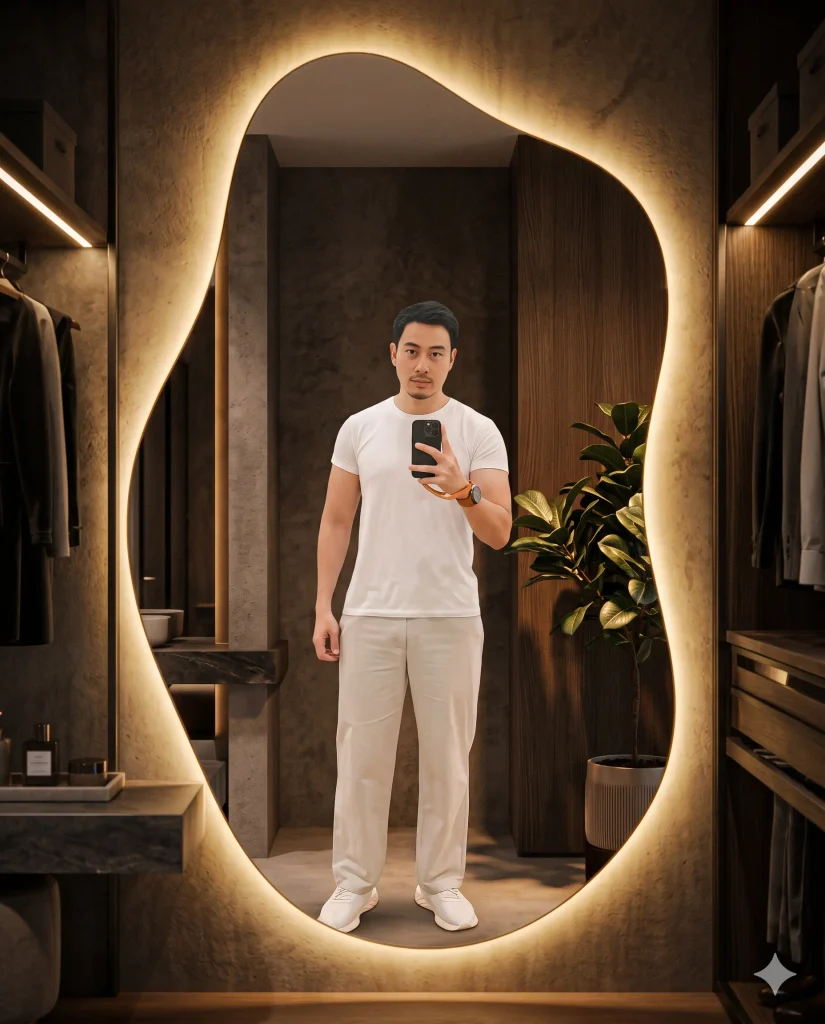
Automatically analyze both uploaded images. IMAGE 1 is the source image containing the person, and IMAGE 2 is the destination image containing the empty mirror. Replace only the empty mirror’s reflection in IMAGE 2 with a realistic reflection of the exact person from IMAGE 1, making it appear as though the person was naturally standing or positioned in front of the mirror when the destination photo was taken.
1. Strict Identity Preservation
Preserve the person’s real identity from IMAGE 1 with maximum possible accuracy. Maintain the original facial features, facial geometry, eyes, eyebrows, nose, lips, jawline, skin tone, natural skin texture, hairstyle, hairline, age, body proportions, and recognizable appearance. Retain the original expression and natural imperfections wherever visible. Do not beautify, retouch, reshape, smooth, regenerate, or reinterpret the face. Do not create a similar-looking person or substitute a synthetic face. The result must remain faithful to the actual person in the source image.
2. Automatic Mirror Detection and Alignment
Intelligently identify the mirror in IMAGE 2 and analyze its exact outline, dimensions, shape, orientation, perspective, curvature, camera angle, and position within the scene. Support all mirror types, including rectangular, arched, circular, oval, irregular, asymmetrical, designer, full-length, floor-standing, wall-mounted, and luxury decorative mirrors.
Place the person from IMAGE 1 naturally within the mirror’s reflective surface. Automatically calculate the appropriate scale, position, distance, crop, framing, body alignment, and perspective to create a convincing reflection that fits the mirror without extending beyond its boundaries.
3. Natural Pose and Reflection Integration
Adapt the person’s positioning only as necessary to achieve realistic alignment with the destination mirror. Preserve their original facial identity and body proportions. When the source pose differs from the required mirror composition, make only minimal, physically plausible adjustments to the visible body positioning.
Respect realistic mirror-reflection behavior, including viewing angle, orientation, perspective, depth, and visible body proportions. Ensure that the person appears to be standing, sitting, or posing naturally in front of the mirror rather than pasted onto its surface.
4. Preserve the Destination Environment
Keep IMAGE 2 as the primary composition. Preserve the original mirror frame, surrounding walls, furniture, room layout, decorations, lighting, shadows, colors, textures, camera position, and overall interior design. Do not replace the room, redesign the mirror, alter the background, or introduce unnecessary objects.
Retain the original source image’s clothing, accessories, hairstyle, and other visible personal details whenever possible. Match the reflected person’s brightness, white balance, exposure, contrast, sharpness, and color temperature to the destination environment.
5. Photorealistic Reflection and Seamless Blending
Create a physically convincing mirror reflection with consistent lighting, realistic depth, accurate perspective, natural edge transitions, and appropriate reflections and shadows. Match the mirror’s surface characteristics, including subtle glare, reflections, and existing highlights, without obscuring the person’s recognizable features.
Ensure that the reflected person appears to belong naturally in the original photograph. Avoid cutout edges, floating body parts, duplicated limbs, distorted hands, incorrect anatomy, mismatched lighting, artificial skin, excessive sharpening, blurry facial features, and obvious AI-generated artifacts.
6. Universal Image Compatibility
Automatically adapt the process to different source images, including selfies, portraits, mirror selfies, standing poses, sitting poses, indoor photographs, outdoor photographs, half-body portraits, and full-body images. Handle different image aspect ratios, resolutions, camera angles, mirror sizes, and compositions intelligently.
If only part of the person can realistically fit within the mirror, show only the appropriate visible portion. Never stretch, compress, or unnaturally distort the person to force a fit.
7. Final Output Requirements
Produce one high-resolution, photorealistic edited image using IMAGE 2 as the unchanged base photograph, except for the necessary modifications inside the mirror’s reflective area. Preserve the original scene and mirror design while seamlessly integrating the person from IMAGE 1.
Priority order: Exact identity preservation → realistic mirror perspective → natural body proportions → seamless lighting and blending → preservation of the destination environment.
Final instruction: Replace the empty mirror reflection only. Do not modify the person’s identity, unnecessarily alter the surrounding scene, or generate a new photograph from scratch. The finished result should look like an authentic photograph captured with the person naturally reflected in the original mirror.